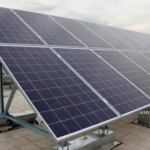
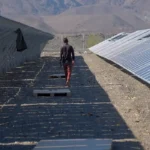
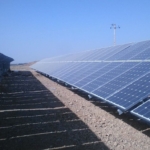
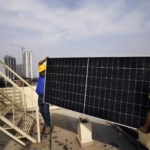
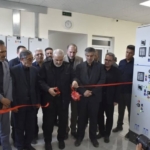
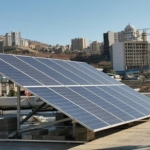
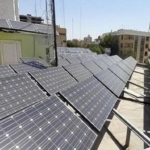
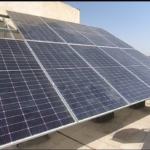
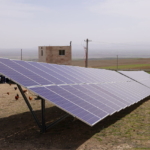
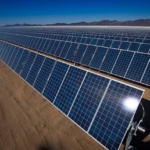
Solar power plants with the capacity of 11.5 megawatts (MW) were put into operation in Khorasan Razavi province, in the northeast of Iran, on Monday morning.
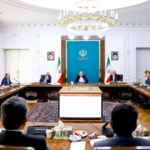
Iran's Supreme Economic Coordination Council, led by President Masoud Pezeshkian, has approved new financial incentives to encourage private sector involvement in renewable energy development, specifically solar panel purchases and installation.
Iran's Energy Minister, Abbas Aliabadi, has announced a 100-megawatt renewable energy project, aiming for the total installed capacity to surpass 3,000 megawatts by March 2026.
Referring to the government's policy of developing solar power plants in the country, the director of the engineering office of the Iranian Water and Power Resources Development Management Company said: "Based on this, the construction of solar power plants next to dams has been put on the agenda."
Iranian energy minister announced that next week, three new packages, one conventional and two more technical models, will be unveiled for the construction of household solar power plants.
India's renewable energy sector faces financial challenges as subsidy ends, requiring projects to pay transmission costs after June, potentially increasing green energy tariffs and hindering clean energy goals.
Iran's Energy Minister, Abbas Aliabadi, launched 316 megawatts of solar capacity across 40 sites, praising local efforts in Mahallat County for driving renewable transition and reaffirming government support for solar investment.
The central Iranian province of Markazi has significantly expanded its solar power infrastructure, with 500 small-scale solar power plants connected to the national grid, a senior energy official announced.
Iran has equipped 1,239 government offices with solar panels as part of a nationwide energy-saving initiative, an official from the state-run Power Generation, Distribution and Transmission Company (Tavanir) said.
Iran installed approximately 600 megawatts (MW) of solar power capacity in the past Iranian year (ending March 2025), marking a fourfold increase over the previous annual average of 150 MW, according to Alireza Parandeh Motlaq, deputy head of the Renewable Energy and Energy Efficiency Organization (SATBA).
Iranian President Masoud Pezeshkian referred to the government's strategy for expanding renewable energies, and stated that the movement in this direction has begun and is being followed continuously and regularly in daily and weekly government meetings.
Iran will inaugurate its first biorefinery this week in the western province of Kermanshah, with President Masoud Pezeshkian expected to attend the opening ceremony, according to a senior official from the Ministry of Industry, Mining and Trade.
India and Angola have decided to expand their energy partnership with New Delhi also offering to share its experience in digital public infrastructure, space tech and capacity building with the African nation.
Iran’s Energy Ministry announced on Thursday that 15 newly constructed solar power plants with a combined capacity of 100 megawatts are ready for operation across the country, despite a delay in the official inauguration ceremony originally planned for this week.
Iranian President Masoud Pezeshkian said that his administration is committed to supporting investment in renewable energy, unveiling incentive packages aimed at encouraging private and public sector participation in the sector.
Indian state power company NTPC is looking to build 30 gigawatts (GW) of nuclear power capacity over the next two decades, three times more than expected, at a cost of $62 billion, three sources said.
has signed an agreement with private investors to develop solar power plants by the summer of 2025, aiming to address the country’s electricity supply imbalance.
India is looking to expand its investments in Argentina's mining, gas and oil sectors, with a focus on lithium, to secure resources needed for its energy transition, the country's mining secretary told Reuters.