First gas from Australia’s Beetaloo puts shale ambition to the test
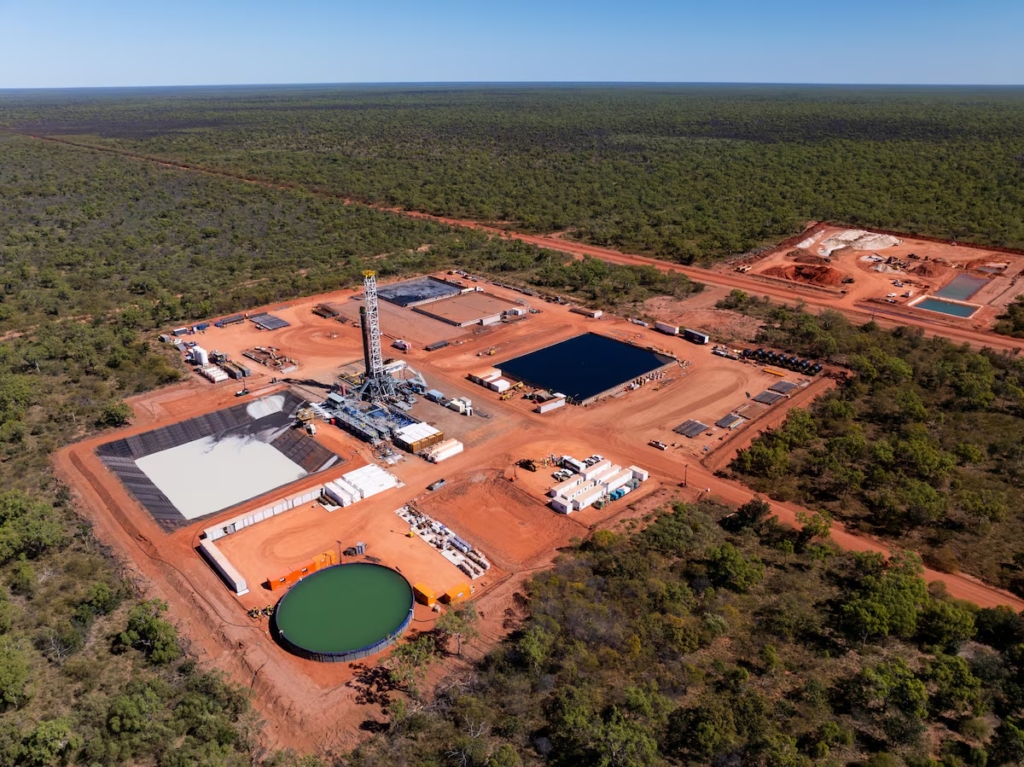
RoydadNaft – Deep in Australia’s Red Centre, gas is set to start flowing next month from the sprawling Beetaloo basin to Darwin 500 km (310 miles) north, in what developers hope kicks off the country’s own U.S.-style shale revolution.
The prospects for the Beetaloo are vast. Geoscience Australia data shows it holds 7 trillion cubic feet of gas, fuelling local government dreams it will power data centres in the underdeveloped Northern Territory and feed liquefied natural gas sales to Asia from the world’s second-largest LNG exporter.
Tamboran CEO Todd Abbott, who joined in January from U.S. shale producer Seneca Resources, said in a decade the company expects to be producing more than 1 billion cubic feet of gas per day. That could fuel a 9% increase in Australia’s LNG export capacity.
OLD ROCKS, NEW MONEY
The Beetaloo is frequently compared with the Marcellus shale in the U.S. but is far older at 1.3 billion years versus around 400 million, with much harder, more compacted rocks as a result.
It is also unique among shale plays, such as in the U.S. and Argentina, in that it has not already been developed as a conventional petroleum resource, said Martin Wilkes, a principal at RISC Advisory in Perth. So it lacks infrastructure.
So far, Tamboran and its partners have spent A$1 billion ($713 million) on exploration and appraisal drilling, a spokesperson said.
To fund development, Tamboran raised over A$280 million in April in Sydney and New York, where it listed in 2024 to tap investors more familiar with shale projects.
“You need a party with deep pockets who’s willing to deploy billions of dollars over several years before being able to prove up a large-scale commercial play, and they’ve never had that until now,” said MST Marquee analyst Saul Kavonic.
An Inpex spokesperson said the company had recognised the potential of the Beetaloo since 2012, when it greenlit its Ichthys LNG plant in Darwin.
There is no shortage of potential demand for Beetaloo gas.
Inpex has said the gas could help fill Ichthys or underpin an expansion.
SHALE NEEDS SCALE
To match the U.S. shale revolution, scale and cost-cutting will be key.
Beetaloo CEO Alex Underwood said a small number of wells is expensive but costs fall once drilling is continuous.
“Understanding the interplay between capital expenditure and production profiles will really be the key determinant of how to scale up production in the future,” he said in an interview.
Developers plan to use locally produced sand in their hydraulic fracturing, which Beetaloo Energy estimates could save A$5 million per well in transport expenses, a 15% reduction.
“It’s minute efficiency everywhere. Pushing everything to its limit is what’s making this stuff economic,” Wood Mackenzie analyst Anne Forbes said.
($1 = 1.4025 Australian dollars)