Reuters: Global LNG Prices Could Surge This Winter as European Storage Hits Multi-Year Lows
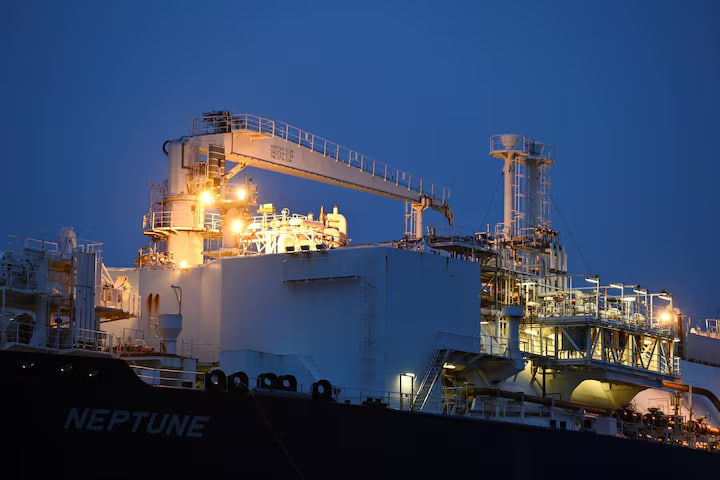
RoydadNaft – Global liquefied natural gas (LNG) prices could rise sharply this winter as European gas inventories sit at their lowest levels in years and buyers in North Asia compete more aggressively for cargoes. The Strait of Hormuz also remains closed because of the U.S. war with Iran.
Energy executives and analysts speaking at the Gastech conference in Bangkok said Europe will enter the winter season with storage levels below last year’s, leaving the region more vulnerable than usual.
The conflict with Iran has also blocked Qatar and the United Arab Emirates from exporting LNG through the Strait of Hormuz. Shell said that disruption has already removed 36 million metric tons of LNG supply from the market this year.
Cedric Cremers, a senior Shell executive, said Europe is heading toward the end of autumn with historically very low inventories.
European Union natural gas storage is currently about 67% full — a record low for this point in the year and well short of the EU’s target of 80% by December. Executives at Norway’s Equinor said inventories could reach 75% by November 1.
Unlike the 2022 Ukraine crisis, European countries did not rush to refill storage over the summer. In a market stuck in backwardation — where prompt prices sit above prices for later months — there was little financial incentive to do so.
Anatol Feygin, chief commercial officer at Cheniere Energy, said Europe is heading into this winter in a very difficult position.
Germany’s state-backed energy company SEFE said Wednesday that inventory builds have now begun as Europe approaches winter with the lowest storage levels in recent years.
Industry executives said Asian spot LNG prices have nearly tripled this year to around $30 per million British thermal units (mmBtu), up from about $10 before the war. The rally has already started to curb demand.
Simon Flowers, chairman of consultancy Wood Mackenzie, said a cold winter would pose a serious risk because there is very little spare supply available. “That will really test the market,” he said.
If winter is colder than normal, prices could climb to $40 per mmBtu — roughly equivalent to $240 a barrel of Brent crude. Prices that high would likely destroy demand, Flowers said.
If the winter turns out warm, prices would still stay elevated but might not rise much further from current levels, he added.
He also noted that, given the intensification and spread of the Iran war, restrictions on the Strait of Hormuz are likely to last through the end of the year.
Helle Ostergaard Kristiansen, Equinor’s senior vice president for marketing and supply, told Reuters that if Europe and Asia both have a cold winter and Hormuz disruptions continue, European buyers will likely have to compete with Asian buyers for U.S. LNG cargoes.
Andrew Berry, ExxonMobil’s vice president of global LNG marketing, said the 45-day voyage from the United States to North Asia can be difficult for Asian buyers that need ships in position quickly to meet demand.
“This winter can definitely be a challenging period.”
Cremers of Shell said: “We can all hope for a warm winter. But given what we’ve seen over the past few years, there will almost certainly be a greater need to refill storage heading into winter — and that need will continue afterward as well.”