Global Crude Oil Price Today (July 16, 2026) / Brent Oil Price Falls to $84.68
RoydadNaft – Brent crude futures fell 27 cents, or 0.32%, to $84.68 per barrel. U.S. West Texas Intermediate (WTI) crude futures dropped 11 cents, or 0.14%, to $79.49 per barrel.
According to Roydad Naft, oil prices traded with relative calm on Thursday as traders assessed escalating tensions between the United States and Iran and the risks to oil supplies passing through the Strait of Hormuz.
Brent crude futures declined 27 cents, or 0.32%, to $84.68 per barrel (at 10:11 GMT), while U.S. WTI crude futures fell 11 cents, or 0.14%, to $79.49 per barrel. Both contracts remain near their highest levels in a month.
Ole Hansen, market analyst at Saxo Bank, said: “The market is still reacting with a surprising degree of calm.”
“It seems reasonable that prices could head toward $90–$95 and even test the $100 mark again, as the Strait of Hormuz has faced repeated disruptions, creating uncertainty around oil flows from the Persian Gulf.”
The United States attacked Iranian coastal defensive facilities and missile bases on Wednesday after reimposing a naval blockade on Iranian ports, while Tehran threatened to cut off more regional energy exports and declared it was engaged in an “existential war” with America.
This escalation followed the collapse of a fragile ceasefire established in June, reviving fears of a return to full-scale conflict and major disruptions to energy flows through the Strait of Hormuz — a chokepoint that handled about one-fifth of global daily oil and liquefied natural gas trade before the war began.
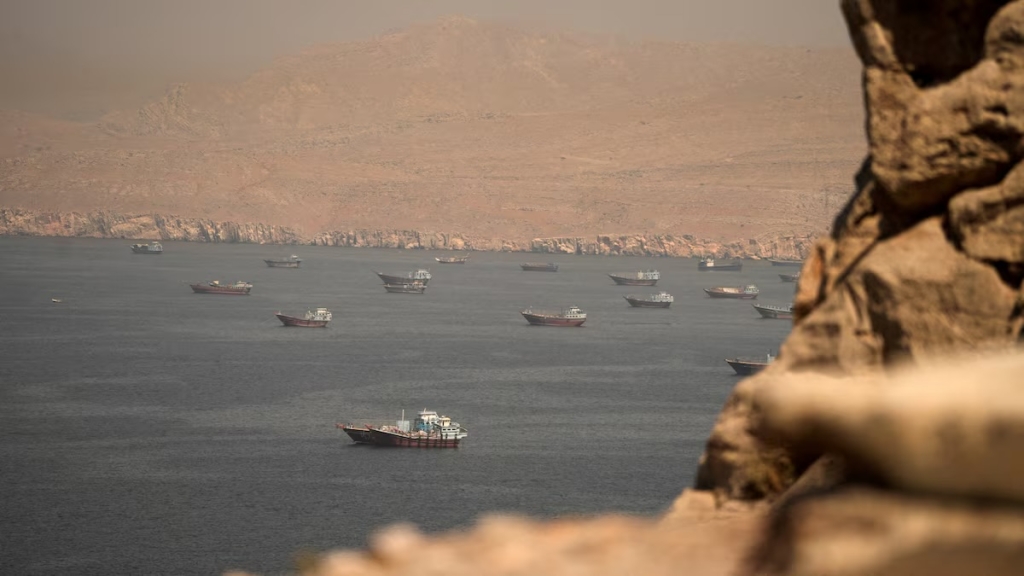
The number of vessels transiting the Strait of Hormuz fell on Wednesday — the first day after the U.S. reimposed its naval blockade on Iran. Only seven ships passed through, compared to 13 the previous day.
Wael Makarem, senior financial markets strategist at Exness, said: “Markets may remain cautious while assessing immediate supply risks. So far, despite the high level of military tension, oil tankers continue to pass through the Strait of Hormuz, albeit in smaller numbers.”
Iran declared on Thursday that the Strait of Hormuz is an inviolable “red line” and warned that if U.S. President Donald Trump carries out his threat to strike Iranian infrastructure, it would target infrastructure across the entire Persian Gulf region.
Analysts say Iran has signaled it may use its Houthi allies in Yemen to close the Bab el-Mandeb Strait to the Red Sea, opening a new front against Washington and endangering the world’s second vital energy artery.
Oxford Economics stated that the most likely scenario is lower and more volatile traffic through the strait, causing occasional price spikes that would keep average oil prices above $80 per barrel for several quarters.
Elsewhere, Ukraine’s Security Service announced on Thursday that, in coordination with the Ukrainian Navy, it had struck two Russian “shadow fleet” oil tankers with sea drones in the Black Sea.