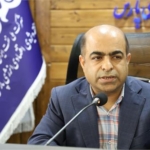
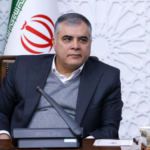
The Director of Labour and Employment Services at the Pars Special Economic Energy Zone Organisation has emphasised the need for early planning and announced the development of a coherent programme to hold even more magnificent celebrations for International Workers’ Day next year, drawing on the successful experience of this year’s event.
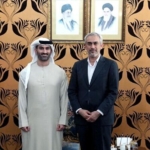
Iran has invited Emirati investors to participate in major projects across its economy, the country’s economy minister said during a meeting with the United Arab Emirates’ new ambassador to Tehran.
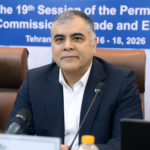
Iran’s oil minister said agreements reached with Russia have entered the implementation phase following the conclusion of the 19th Iran-Russia Joint Economic Commission.
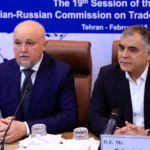
Russia’s energy minister said a comprehensive agreement signed by the presidents of Iran and Russia, along with the outcomes of recent expert-level meetings, has paved the way for a new cooperation protocol and a fresh phase in ties between Tehran and Moscow.
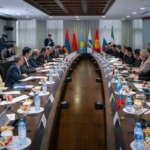
Iran and Russia are aiming to increase their annual bilateral trade to $20 billion, a senior Iranian oil ministry official said Monday, as the two countries opened a joint economic commission in Tehran.
Iran’s unemployment rate reached 7.8 percent in autumn 1404 (September-December, 2025), marking a 0.6 percentage point increase compared with the same period last year, according to new data released by the Statistical Center of Iran.
Iran's parliament has set the National Development Fund's share of oil export revenue at 20% in next Iranian year's budget, which begins in March 2026.
Iran’s oil minister marked the 47th anniversary of the Islamic Revolution by stressing the need to preserve unity within the oil industry, strengthen domestic capabilities and make full use of human capital, saying the sector plays a central role in countering external pressure and boosting the country’s economic resilience.
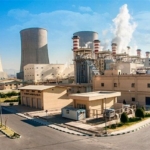
Iran ranks among the world’s 10 countries with the largest thermal power generation capacity, a senior official at the Thermal Power Plants Holding Company (TPPH) said.
Iran has allocated $48.7 billion in foreign currency for the import of various goods since the start of the current Iranian year (late March 2025), with 73 percent directed to the industrial sector, the spokesperson for the Iran Exchange Center said.
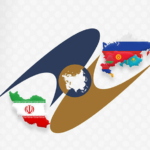
Iran’s trade with member states of the Eurasian Economic Union (EAEU) increased 16 percent in the first eight months of the current Iranian year (Mar. 21st-Nov. 22nd) the head of the Trade Promotion Organization of Iran said.
minister put the total value of a contract signed by the National Iranian Oil Company on guaranteed purchase of drilling services at about $1 billion, explaining that 20 drilling rigs of 2,000 horse power will be added to Iran’s drilling fleet in five years.
U.S. oil executives are hesitant to pour billions into Venezuela’s battered industry, insisting on ironclad legal and financial guarantees from Washington before backing Trump’s plan to revive production after Maduro’s capture. Talks ongoing ahead of White House meeting.
Iran’s President Masoud Pezeshkian said the government’s reforms to gasoline and diesel pricing aim to eliminate rent-seeking and capital flight by depositing energy credits directly and fairly into people’s bank accounts.
In line with the implementation of Iran's free trade agreement with Eurasia, the fourth International Eurasia Expo will be held in Tehran from February 1st to 4th.
Trade between Iran and Oman reached $1.35 billion in the first 10 months of 2025, up 24 percent from a year earlier, with Iranian exports accounting for $500 million of the total, Oman’s National Centre for Statistics and Information said.