Canada’s historic first cargo of LNG sets sail for buyers in Asia
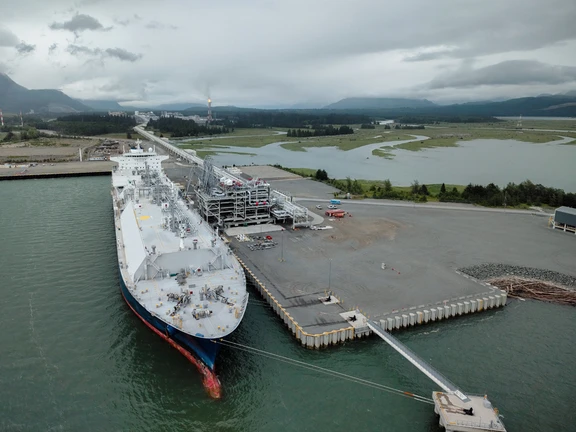
RoydadNaft –A tanker carrying the first cargo of liquefied natural gas from LNG Canada set sail Monday from British Columbia’s northern coast, heralding the commercial startup of the $18-billion Shell PLC-led export terminal and ushering in Canada’s long-awaited debut into the global LNG market.
The GasLog Glasgow, a vessel chartered by Shell, arrived early Saturday at the Port of Kitimat for loading and is expected to deliver the country’s first large-scale cargo of LNG to Asia in the coming days.
“We’re helping Canada diversify its export markets, and, in doing that, we’re providing a secure supply of energy to folks in Asia who are looking to further decarbonize,” he said.
The inaugural cargo comes nearly 15 years after the first application for a licence to export LNG from the West Coast was submitted to federal regulators. Since that time, more than a dozen LNG projects aiming to capitalize on Canada’s shorter shipping distances to Asia and abundant supply of natural gas have come and gone amid political flare-ups over pipelines, tightening environmental standards and shifting global market dynamics.
Energy producers in Western Canada and their investors have waited impatiently for LNG Canada’s startup, hoping to see a boost in returns as growing volumes of gas begin making their way to Canada’s West Coast for export — something akin to the uplift in Canadian crude prices that followed the Trans Mountain pipeline expansion (TMX) project — but so far experts say there are few signs that the newly commissioned facility is having a material impact on markets.
Prices for Western Canada’s natural gas, which trade at a discount to Henry Hub, have been hit hard by a combination of high storage inventories and pipeline flow restrictions that kept the average cash price for AECO, Canada’s primary gas price benchmark, below $1/MMBtu in June.
“We’re dealing with a market that’s extremely oversaturated and there’s lots of gas available,” Archer said. “Similar to TMX, we do anticipate that there’ll be an impact (from LNG Canada) on prices, but we’re not seeing it yet and we expect it’ll probably take a little bit of time to happen.”
Despite the near-term price doldrums, Canada’s energy sector has been buoyed by growing anticipation of a structural increase in demand for natural gas across North America, driven by U.S. LNG export capacity nearly doubling by the end of the decade to between 24 and 26 Bcf/d.
Canada’s nascent LNG industry could also grow substantially by the end of the decade, from the roughly 2.5 Bcf/d currently under construction or operating, to more than 6 bcf/d if existing projects proceed as planned — including a Phase 2 expansion of LNG Canada which would double the facility’s capacity to 28 mtpa.
“We expect natural gas prices to strengthen to between $4 and $5 over the coming year, and as Canada increases its LNG capacity, we think the current discount on Canadian natural gas should fall from about $2 today, to between $1.10 to $1.30,” Toronto-based investment firm Ninepoint Partners LP wrote in its 2025 mid-year outlook published last week.
LNG Canada’s joint-owners — Shell, Malaysian energy giant Petronas, PetroChina, Mitsubishi Corp. and Kogas — are currently deciding whether to green-light Phase 2 and Cooper said the partners are closely watching the facility’s startup.
“We just want to see all that working: the supply chain, the logistics and how all that works,” Cooper said, adding that the partners will be weighing the cost of expanding the project and the competitiveness of Canadian LNG, as well as other considerations around Canada’s policy environment, concerns over greenhouse gas emissions and input from stakeholders.
“So you’ve got one bit, which is (getting) Phase 1 working, and the second bit, which is actually proofing out the economic proposition for Phase 2,” he said.
A report earlier in June that Petronas was exploring the sale of its Canadian assets — a claim the company has since emphatically denied — may have reignited long-standing concerns in Canada’s energy sector over the potential flight of global investment. But Cooper said all five joint-venture partners in LNG Canada remain “very interested” in the project’s expansion.
“We continue to work with our five joint venture partners who invested in Phase 1 and we don’t see that changing at the minute.”
Prime Minister Mark Carney said Monday that Canada “has what the world needs” in a statement responding to news of the first cargo’s departure.
“With LNG Canada’s first shipment to Asia, Canada is exporting its energy to reliable partners, diversifying trade, and reducing global emissions — all in partnership with Indigenous Peoples,” he said. “By turning aspiration into action, Canada can become the world’s leading energy superpower with the strongest economy in the G7.”