
What growing oil exports mean for Iran’s economy
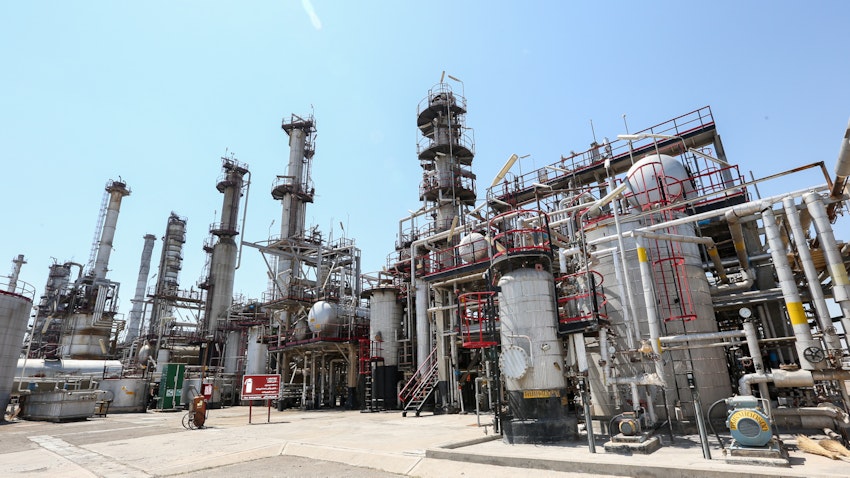
Over the last few weeks, various reports have emerged on Iran’s increased crude oil sales. The most recent report by monitoring service TankerTrackers indicates that Aug. 2023 saw the highest volume of Iranian exports since 2018, when the Donald Trump administration unilaterally left the 2015 Iran nuclear deal and reimposed all sanctions.
Last year, Iran’s revenues from the export of crude oil and condensate reached 42.6B USD, compared to 25.5B in 2021, 7.9B in 2020, and 19.4B in 2019. The peak of export performance in recent years was in 2018, with 60.5B USD in revenues.
A continuation of the Aug. 2023 export level of 2.2M barrels per day (bpd) through the end of this year would put Iran back at a respectable level of production and exports, though it would still be well below the peak export performance of 2.8M bpd in Sept. 2017.
Rise in exports amid changed trade patterns
Four reasons can explain the increase in Iran’s exports. First, it seems that the Joe Biden administration has eased its enforcement of US sanctions on Iranian petroleum exports. It is not clear whether this move is connected to the relative “de-escalation” between Tehran and Washington or the current tense situation in the global oil market.
Second, Tehran’s offer to blend its crude oil to the API gravity that interested refiners need is enticing to many players in China and elsewhere in Asia. This means that in addition to the discount that customers receive, Iran also provides them with ready feedstock for their refineries.
Third, global demand for oil is growing. Daily demand has increased from 97M bpd in 2021 to 101M bpd in 2023. With OPEC+—an alliance between the oil cartel and other major producers such as Russia—not increasing production, Iran remains one of few producers that can increase its exports while still being within its OPEC quota.
Last but certainly not least, Iran and its international trustees are getting more sophisticated in circumventing the US export and banking sanctions.
Experts agree that Iran’s additional exports are mainly flowing to China at discounted prices. However, over the past few years, a significant shift has occurred. As recently as 2019, most of Iran’s crude oil was exported to state-owned Chinese refineries. According to various sources, presently, almost 90% of Iran’s exports are instead acquired by private refineries in China.
Based on an agreement between the two governments, proceeds from oil sales to state-owned Chinese refineries are put into an escrow account with the National Bank of China and then used to finance Iranian imports from China. However, proceeds related to sales to private refineries are looped back to Iranian trustees in third countries.
Even though the transactions through trustees are subject to a 5-10% fee, the Iranian exporters—in this case the government—can decide how to use the funds and are not obliged to use them for imports from China. In other words, funds are more readily available for the government to utilize.
Utilizing additional oil income
Considering that Iran’s current state budget is based on an export performance of 1.3M bpd, it is clear that petroleum revenues will generate a surplus for the government. In monetary terms, the budget was based on the export of 1.3M bpd at a barrel price of 85 USD. The current picture is a daily export volume of 2.2M bpd at a price of 80 USD. Of note, there is no need to take into account discounts and fees as they would be similar in both cases. As such, Iran is essentially achieving a 44% higher revenue compared to the projections in its budget. The question is how this surplus will impact the country’s economy.
First and foremost, the additional income is very positive for the National Iranian Oil Company (NIOC), which is allocated 14.5% of petroleum revenues for its operational and capital expenses. A more than 40% increase in NIOC’s revenues would allow the company to make some needed investments and create a small momentum in various subcontracting industries in the country. This will impact the overall climate for investments in related industries, and also create much needed jobs.
In macroeconomic terms, the government should have funds to fill its endemic budget deficit this year. Moreover, even though inflation has not shown any improvement, experts expect that it will ease once the financial cycles kick into the economy.
Ironically, the latest official monthly inflation figures for the Iranian month of Mordad (ended on Aug. 22, 2023), stood at 2.4%, higher than the previous month at 2.0%. Officials had forecast that monthly inflation would drop below 2%—a shift that the economy will probably experience later this year. For the year, annual inflation stands at 47.5%—far above the set target of 30%. These figures show that the government’s improved financial position has not yet eased the inflationary pressures on society.
Iranian economist Mohammad Taher Rahimi opinesthat the excess revenues are currently allocated to repaying government debts as well as reviving various infrastructure investments. The indicator he uses to prove his point is capital formation. According to the Central Bank of Iran (CBI), in the Iranian year that ended in Mar. 2023, capital formation saw growth of 6.7% after three years of negative performance. Given the absence of significant private sector and non-governmental investments, the growth in capital formation shows that the government is pumping funds into infrastructure projects. With the additional oil income, it is anticipated that this trend will continue.
Another other important indicator that should be impacted by the higher oil revenues is the open market exchange rate. However, rather than strengthening, the Iranian rial has interestingly held steady at around IRR 490,000 to the greenback.
This could be the result of the CBI managing the market to keep the exchange rate stable and not allow inflationary and other pressures to further destabilize it. Importantly, an appreciation of the rial would also put pressure on Iranian exporters. Therefore, the government and the CBI will likely continue to manage the different rates to induce stability and also eliminate the exchange rate’s impact on inflation.
A further important factor to watch is whether the government will fulfill its legal obligation to pay 40% of oil export revenues to the National Development Fund (NDF). Mehdi Ghazanfari, head of NDF’s board of trustees, mentioned in May that the balance of the fund was only 10B USD, with 40B USD owed to it from loan facilities and 100B USD “borrowed” by consecutive governments. The replenishing of the NDF would allow it to offer loan facilities to strategic economic projects for the country. However, past experience has shown that the NDF has mainly been used to relieve financial pressure on governments that have seldom disbursed the designated allocation of oil export revenues into the fund.
All in all, the improved oil export performance has positive impacts on government finances and the country as a whole. However, there are extensive sources of instability and tension in the economy, meaning that it will take a number of other constructive steps to return the economy to some degree of calm and stability.
source: Amvaj Media