
UAE minister urges Big Oil to join fight against climate change
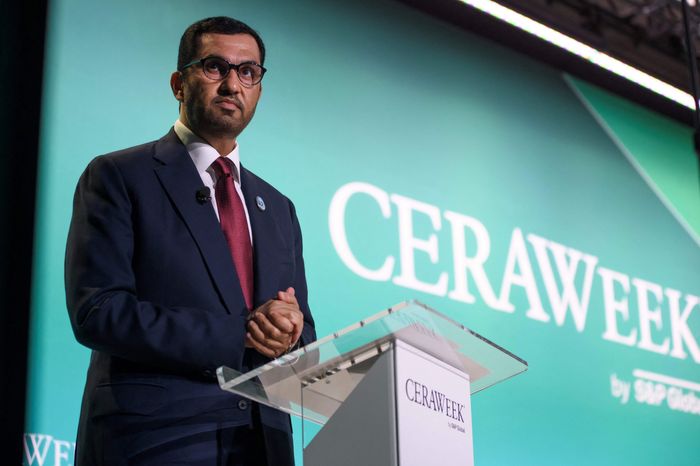
A Cabinet minister and top oil executive from the United Arab Emirates (UAE) on Monday (March 6) urged the energy industry to join the fight against climate change, borrowing a famous line from a US astronaut aboard a damaged spacecraft during the Apollo 13 mission in 1970.
“Houston, we have a problem,” Sultan al-Jaber, UAE Minister of Industry and Advanced Technology and chief executive of Abu Dhabi National Oil Company – who is president-designate of the COP28 climate summit – said to loud applause from the nearly 1,000 attendees of at the CERAWeek energy conference.
“Energy leaders in this room have the knowledge, experience, expertise and the resources needed to address the dual challenge of driving sustainable progress while holding back emissions,” Jaber said in his speech to an audience that included Opec secretary-general Haitham Al Ghais and US climate envoy John Kerry.
Jaber and Kerry, who strode to the stage and shook Jaber’s hand when the speech ended, left the room together. The two held a meeting ahead of the conference on Sunday.
Jaber was a controversial pick to lead the COP28 climate summit because his country is an Opec member and major oil exporter. The UAE is only the second Arab state to host the conference, after Egypt in 2022.
He called on his peers to get behind efforts to limit global warming. “Alongside all industries, the oil and gas needs to up its game, do more and do it faster,” Jaber said.
The UN-backed climate change conference’s recent inclusion of oil and gas representatives is a far cry from 2021 summit, where energy companies complained they were shut out of the event.
Jaber’s appointment as COP28 president last year fuelled activist concerns that the oil industry was hijacking the world’s response to the global warming crisis.
Some activists demanded he give up his Adnoc role to steer the event. Jaber’s COP28 presidency involves shaping the conference agenda and negotiations between governments.
But others say the whole energy industry needs to be involved in the energy transition. Russia’s invasion of Ukraine sparked an energy crunch that underscored continued dependence on fossil fuels and vulnerability to supply disruptions.
On Monday, Jaber emphasised that he would “consult and convene” with all members of the energy world.
“This industry must take responsibility and lead the way,” he said of the oil and gas sector. “Let’s remember that progress is made through partnership not polarisation.”
Separately, US Energy Envoy Amos Hochstein told reporters on the sidelines of the conference that price caps imposed by the Group of Seven (G7) and allies to force Russia to sell its crude and fuel at a discount are working well.
The United States was one of the architects of price caps on Russian oil, which aimed to prevent a major disruption of supplies from Russia but drive down Moscow’s income from crude and fuel exports.
The G7 countries, the European Union and Australia implemented the price cap on seaborne cargoes of Russian oil on Dec 5, setting it at US$60 (RM268.35) a barrel as part of sanctions on Russia for its invasion of Ukraine. On Feb 5, the G7 and allies implemented a price cap on Russian fuel sales.
“I think the beauty of the process is that it is working and that Russian oil and Russian products are being traded below the price cap,” Hochstein said.
Russia, which produces around 10% of global oil supplies, announced in February it would cut output by 500,000 barrels per day, or about 5% of Russia’s output in response to the price cap.
Hochstein said the cut had had little impact on the prices buyers were paying for Russian oil. – Reuters