
Canada and India agree to boost oil and gas trade as energy partnership resets
RoydadNaft – Canada and India have agreed to boost trade in oil and gas as part of a broader effort to reset and strengthen their energy ties.
The announcement came on Tuesday during India Energy Week in Goa, where Canada’s Minister of Energy and Natural Resources, Tim Hodgson, held talks with India’s Minister of Petroleum and Natural Gas, Hardeep Singh Puri.
Under the agreement, Canada will increase exports of crude oil, liquefied natural gas (LNG), and liquefied petroleum gas (LPG) to India. In return, India will supply more refined petroleum products to Canada, according to Bloomberg News.
The meeting signalled the resumption of a high-level ministerial energy dialogue that had been on hold following a diplomatic row sparked by the killing of a Canadian Sikh activist. That channel had previously served as the primary forum for energy cooperation between the two countries.
Speaking at the event, Mr Hodgson highlighted Canada’s past over-dependence on the United States as an export market. “We used to send 98 per cent of our energy exports to just one country. That was a strategic mistake,” he said, according to Reuters. “We’re now fully committed to diversification, and we see real potential in partnering with India.”
He pointed out that Canada is well placed to provide crude oil, LNG, and uranium, noting that India is set to experience the world’s fastest-growing energy demand in the decades ahead. “India will be the fastest-growing source of energy demand globally,” he added.
At present, Canada does not export crude oil or LNG directly to India. India sources most of its oil from Russia, Iraq, and Saudi Arabia, and its LNG primarily from Qatar, based on data from analytics firm Kpler.
In recent years, India’s oil imports have grown steadily (by an average of 2.5 per cent over the past three years), while LNG imports fell by 6.3 per cent in 2025 as gas prices rose and buyers shifted back towards oil. Indian refiners have been particularly active in purchasing discounted Russian crude since Moscow’s invasion of Ukraine, making Russia India’s top supplier.
Analysts suggest Canada’s renewed push comes at a time when India is keen to diversify its energy sources, amid increasing international scrutiny of Russian supplies and uncertainty over potential future sanctions.
Mr Hodgson emphasised that Canada is actively developing the infrastructure needed for Asian exports. “We’re building pipelines to the West Coast—we already have three in place and are planning more,” he said.
The expanded Trans Mountain pipeline now provides a direct Pacific outlet for Canadian crude, although shipments to India have so far mostly routed through the US Gulf Coast, Bloomberg reports. Canada also started exporting LNG to Asia in June 2025, and officials note that its LPG facilities offer shorter shipping distances to India than those on the Atlantic side.
The two countries are also deepening collaboration in clean energy. Their joint statement commits to encouraging mutual investment and exploring joint work in areas such as hydrogen, biofuels, battery storage, critical minerals, electricity grids, and the application of artificial intelligence in the energy sector.
Mr Hodgson added that India’s growing focus on nuclear power could open opportunities for increased Canadian uranium exports.
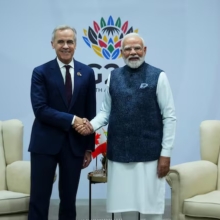
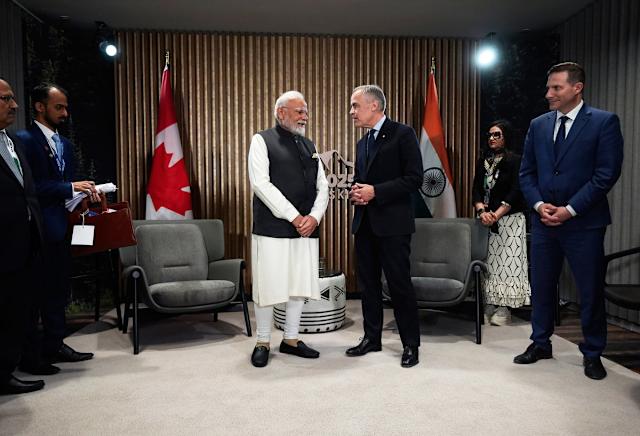
This energy rapprochement forms part of a wider diplomatic thaw under Canadian Prime Minister Mark Carney, who has prioritised diversifying export markets amid escalating trade friction with the United States.
Mr Carney and Indian Prime Minister Narendra Modi revived discussions on a comprehensive economic partnership agreement in November, and the Canadian leader is expected to visit India soon.
Bilateral goods trade between the two nations stood at $9.7 billion in 2024, according to Bloomberg, with Canadian officials arguing there is considerable untapped potential—especially in energy. India currently takes only about 1 per cent of Canada’s critical minerals exports, a figure Ottawa sees as illustrating the room for substantial growth.
The renewed engagement with India comes against a backdrop of complex global trade dynamics. Mr Carney’s forthcoming visit to India will follow his recent trip to Beijing, where Canada and China agreed to lower certain tariff barriers. US President Donald Trump has warned of 100 per cent tariffs on Canadian goods should Ottawa strike what he considers an overly close deal with China—though Mr Carney has made clear that Canada is not pursuing a free-trade agreement with Beijing.
For India, the discussions reflect a strategic push to balance energy security, affordability, and geopolitical considerations as domestic demand continues to climb and global supply chains remain unpredictable.
For Canada, they represent an opportunity to transform newly built pipeline and LNG export capacity into enduring strategic relationships beyond North America.