
India’s Surging Oil Demand Reshapes Global Energy Markets
RoydadNaft – Global energy markets are undergoing a profound transformation as emerging economies shift from agriculture to industry. Among them, India stands out as the single largest contributor to rising oil consumption, fundamentally reshaping international supply chains, pricing, and geopolitical relationships.
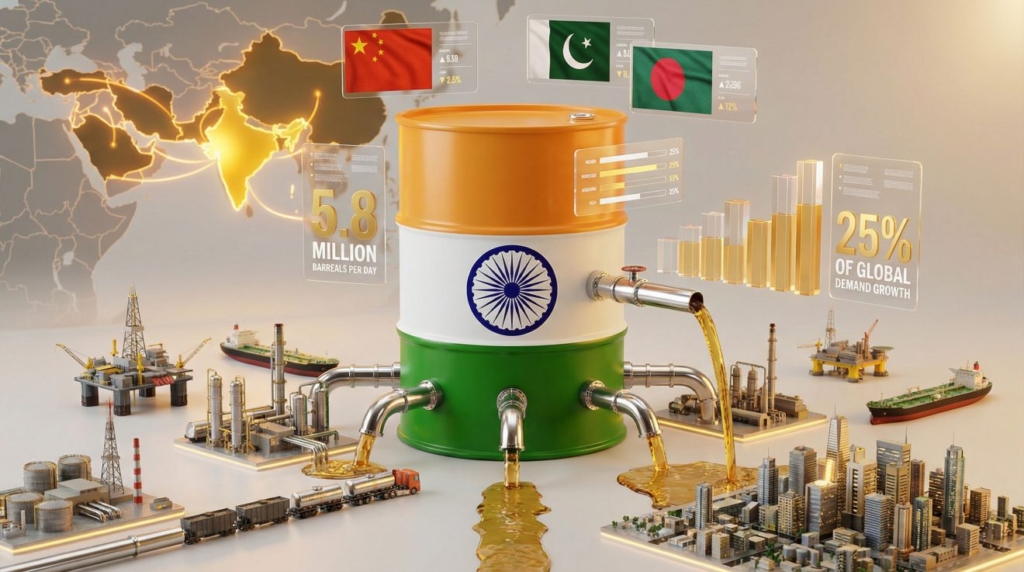
According to the International Energy Agency (IEA), India’s current oil consumption sits at around 5.3–5.4 million barrels per day (mb/d), with projections pointing to 5.8–6.0 mb/d by 2025. This trajectory positions India as the primary source of incremental global demand, accounting for 20–22% of worldwide oil consumption increases.
Unlike China’s earlier industrial-led surge, India’s growth is driven mainly by transportation fuels (65–70% of total demand) and rising middle-class consumption, creating a more resilient baseline that holds up even during economic slowdowns.
| Region | 2025 Demand Growth (bpd) | Primary Drivers | Market Impact |
| India | 150,000–200,000 | Transportation, urbanization | Leading contributor |
| China | 50,000–100,000 | Economic stabilization, EVs | Declining growth |
| Southeast Asia | 120,000–150,000 | Manufacturing expansion | Regional catalyst |
| United States | Variable | Policy shifts, data centers | Demand volatility |
Key Drivers Behind India’s Oil Boom
India’s robust GDP growth (6.4% in 2024, projected at 6.8% in 2025) and rapid middle-class expansion (from 50 million in 2010 to 253–320 million today) are supercharging demand. Urbanization, running at 2.3% annually, further amplifies this through infrastructure projects, logistics, and higher vehicle ownership.
The National Infrastructure Pipeline, with $1.4 trillion planned through 2040, directly boosts diesel use in construction and transport. Meanwhile, booming sectors like e-commerce, plastics (up from 7 million tonnes in 2010 to 16–18 million today), and manufacturing are adding layers of demand.
Import Reliance and Global Supply Shifts
With domestic production covering just 3–3.5% of needs, India’s import dependency hovers at 96.5–97%. This structural gap is widening, even as refining capacity expands to 330–350 million metric tonnes per annum by 2030, positioning India as a regional refining hub and exporter.
India has become a major processor of discounted Russian crude (35–40% of imports), while diversifying suppliers to reduce risks.
Implications for Oil Prices and Energy Transition
India’s steady demand growth provides a floor for global oil prices, while also introducing volatility through seasonal peaks and infrastructure constraints. Fuel subsidies further inflate consumption, though long-term transition to renewables and EVs remains gradual due to infrastructure challenges.
India’s rise marks the last major wave of oil demand from a large emerging economy, with profound implications for upstream exploration, refining investments, and global supply strategies. As the IEA notes, this shift underscores India’s pivotal role in balancing energy security and sustainability in the coming decades.
Disclaimer: This analysis is based on current trends and projections. Actual outcomes may vary due to economic, policy, or geopolitical changes.