
Canada Remains “Globally Irrelevant” as a Critical Minerals Refiner Despite Vast Reserves and New Billion-Dollar Push
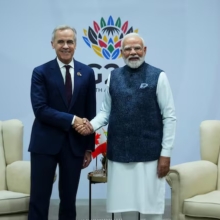
RoydadNaft – Prime Minister Mark Carney returned this week from the United Arab Emirates touting a $70-billion investment package across energy, AI, logistics and mining, while teasing a separate $1-billion initiative to expand Canada’s critical minerals refining capacity. Yet industry data and government figures paint a starkly different picture: Canada is still decades away from even modest relevance in the global refining race dominated by China.
According to the International Energy Agency, China controls an average 70% of refining for 19 of the 20 most strategic minerals, rising to 91% for rare earths, 96% for refined graphite, 78% for cobalt and 70% for lithium in 2024. Canada, despite ranking among the top-10 miners of cobalt, graphite, lithium and nickel, accounts for only about 5% of global mine supply of each and has virtually no downstream refining footprint for the energy-transition metals that matter most.
The country’s only operating rare-earth mine — Nechalacho in the Northwest Territories — is Australian-owned, with ore shipped to Saskatchewan for initial processing and then to Norway for final separation. Canada’s first rare-earth refinery, opened in Saskatchewan in 2024 at a cost of CAD$74 million, is projected to produce a maximum 400 tonnes per year of neodymium-praseodymium (NdPr) metal — less than 0.5% of China’s 2024 output of 83,697 tonnes.
Of Canada’s 32 existing critical-mineral processing plants, just eight are owned by Canadian-domiciled companies; the remaining 24 belong to parent firms in the United States, Europe, Brazil — and in one high-profile case, China (the Tanco lithium-cesium-tantalum mine in Manitoba is 100% Chinese-owned).
Ottawa has tried to jump-start the sector. In October it unveiled the first tranche of G7-aligned critical minerals projects, including offtake guarantees for Quebec’s Nouveau Monde graphite mine and up to $500 million in potential financing for Norwegian firm Vianode’s synthetic-graphite plant in Ontario. Yet analysts note that meeting even domestic demand by 2040 would require roughly $30 billion in new capital — far beyond current commitments.
Canada sits on some of the world’s largest known rare-earth resources (over 14 million tonnes of contained oxides) and ranks third globally in reserves behind China and Brazil, but it has no integrated “mine-to-magnet” supply chain. More than 63% of its critical minerals exports — mostly raw concentrates — go straight to the United States for processing.
Until Ottawa builds substantial domestic refining infrastructure, experts warn, Canada will remain a resource-rich but processing-poor supplier — and effectively irrelevant in the global critical minerals refining landscape that China continues to dominate.