
With US trade war, China now top buyer for Canadian crude on Trans Mountain pipeline

RoydadNaft – China has emerged as the top customer for Canadian oil shipped on the expanded Trans Mountain pipeline, ship tracking data showed, as a U.S. trade war has shifted crude flows in the year since the pipeline started operating.
China’s new interest in Canadian oil comes as U.S. President Donald Trump’s trade war has strained relations between longtime allies Washington and Ottawa. It also reflects the impact of U.S. sanctions on crude from countries like Russia and Venezuela.
Canada is the world’s fourth-largest oil producer, but its main oil-producing province of Alberta is landlocked with limited access to tidewater ports. That means the bulk of Canadian oil – about 4 million barrels per day or 90% – is exported to the U.S. via pipelines that run north-south.
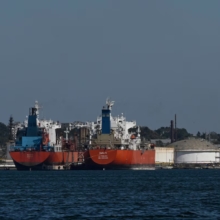
The C$34 billion ($24.40 billion) Trans Mountain is Canada’s only east-west oil pipeline, carrying oil to the Pacific Coast where it can be loaded onto tankers for export. The expansion, which began operations on May 1, 2024, tripled the pipeline’s capacity to 890,000 barrels per day and opened opportunities for Canadian oil along the U.S. West Coast and in Asian markets.
Canada shipped about 207,000 barrels per day (bpd) on average to China since the Trans Mountain expansion ramped up to full operations in June last year, ship tracking data on Kpler showed. That was a huge increase from an average of about 7,000 bpd in the decade to 2023.
The U.S. took about 173,000 bpd from the pipeline in the same period.
Many expected its barrels to land on the West Coast versus Asia, which has access to cheaper Russian oil.
However, Trump’s protectionist policies have in recent months made Canada more attractive to Chinese buyers, said Philippe Rheault, director of the China Institute at the University of Alberta.
China has also been reluctant to be over-reliant on Russian energy supplies, Rheault said.
“A lot of China’s refineries are also mindful of U.S. sanctions, and so have been trying to diversify away from oil from Venezuela and other places,” he added.
SHIFTING FLOWS
In the year since the pipeline’s expansion, Canadian exports of crude to countries other than the U.S. rose nearly 60% to an annual record of about 183,000 bpd in 2024, according to Statistics Canada.
Other nations taking Canadian crude include South Korea, Japan, India, Brunei, and Taiwan, ship tracking data showed.
TMX was about 77% full on average in 2024, according to documents it filed with the Canada Energy Regulator, below the 83% the company forecast, in part due to the high tolls the operator has been charging to make up for cost overruns during construction.
Given China’s increased desire to find new, stable supplies of crude, the bulk of any additional capacity on TMX is likely to go to Asia rather than the U.S. West Coast, said Skip York, chief energy strategist with Turner, Mason & Company.
“I think you’re going to see virtually all of those incremental vessels flow west” for export to China, he said.
($1 = 1.3936 Canadian dollars)